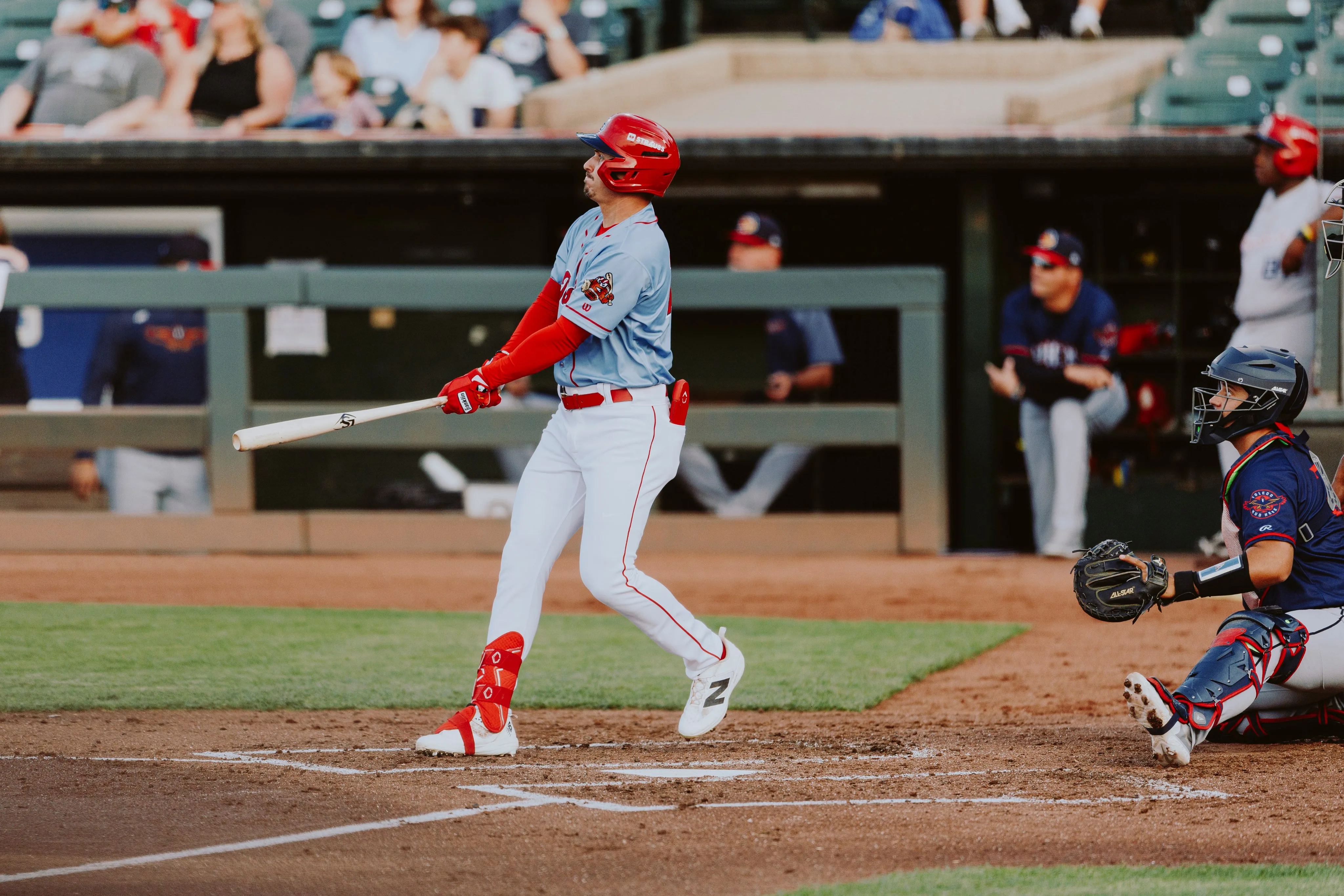
▶ TLDR
JJ Bleday is a 28-year-old left-handed outfielder the Reds just called up from Triple-A Louisville. He was the fourth overall pick in the 2019 draft, but his career batting average is .215 across 1,527 major league plate appearances. That number doesn't tell the full story. His walk rate has been above average every season, his hard-hit rate has improved four years running, and his 2025 regression was caused by a deliberate swing change he's since reversed. At Louisville, his exit velocity jumped five mph above his career MLB average, his barrel rate nearly doubled, and his expected production was backed by legitimate contact quality. The open question is whether the Louisville version of his swing survives the transition to major league pitching.
If you're new to baseball: When scouts evaluate a hitter, they look at how hard the ball comes off the bat (exit velocity) and at what angle it leaves (launch angle). A hard-hit ground ball is usually an out. A hard-hit line drive or fly ball is usually a hit or a home run. Bleday has been hitting the ball harder every year, but too often on the ground. The question is whether a recent swing adjustment changed that.
The short version: Bleday is a patient hitter with moderate power who's here because the Reds need outfield help and he earned the call with a monster month in Louisville. Watch his ground-ball rate. If it stays under 30 percent, the new swing is working. If it climbs back above 40, he's reverted to the version that didn't work.
JJ Bleday was the fourth overall pick in the 2019 draft out of Vanderbilt, and he has a .215 career batting average to show for it.
He hit .167 in his first 65 games with the Marlins, .195 the next year with Oakland, and then had a genuine breakout in 2024: .243 with 20 home runs and a 120 wRC+ (where 100 is league average) across 159 games. Then a bad regression in 2025 — .212, 14 homers, 90 wRC+.
Oakland non-tendered him after the season, but his market was thin and Cincinnati signed him for only $1.4 million. The price was hard to beat, but he still didn't make the Opening Day roster.
But, soon enough, the Reds' outfield needed help. Eugenio Suarez went on the 10-day injured list on April 23 with a mild oblique strain, Will Benson was hitting under .190 with zero home runs, and TJ Friedl and Rece Hinds were both below .200. The team was 17–9 despite the cold bats, but the offense was bleeding from the corners.
Meanwhile, Bleday had adjusted his plate approach and was raking in the minors. So when the Reds needed an outfielder from Louisville, Bleday was the obvious choice over Noelvi Marte, Blake Dunn, Edwin Arroyo (or Hector Rodriguez, who's intriguing but still only 20 and unproven) because nobody else available was hitting like he was.
Blog Red Machine's Tremayne Person called it a week before it happened, writing that teams love when the decision gets made for them. Suarez's oblique made the decision necessary, but Bleday's performance in the minors made it easy.
Bleday's walk rate has been above the league average of 8 or 9 percent in every MLB season he's played: 12.6 percent in 2022, 13.9 in 2023, 10.4 in 2024, 10.5 in 2025. That kind of patience is a skill, and it doesn't fluctuate the way batting average does. His hard-hit rate has gone up every year too — 33.8 percent, 35.3, 36.2, 38.7 — which means he's been hitting the ball harder every season, even as his results got worse.
There's a stat called expected weighted on-base average, or xwOBA. It estimates what a hitter's production should be based on how hard and at what angle he hit the ball, stripping out the luck of where balls land. If a hitter's xwOBA is higher than his actual results, the hits should be coming; if it's lower, the results have been flattering him.
Bleday broke his own swing in 2025, reversed the change this spring, and the data from Louisville is the best evidence yet that the 2024 swing came back with him. The question is whether it survives major league pitching.
The 2024 version of the swing was the one that worked. His exit velocity averaged 88.5 mph that year, roughly league average, but his attack angle sat at 10.6 degrees. Think of attack angle like the angle of a ramp: steeper means the bat sweeps upward more aggressively, generating fly balls and home runs but also more swings and misses. At 10.6 degrees, Bleday was meeting the ball on a flat, efficient plane that drove the ball for singles instead of doubles and homers.
His swing length was 7.28 feet, right at the league average, and his strikeout rate dropped to 19.5 percent — the only season of his career it's been below 23. He posted 3.2 WAR, and for one full season, the results matched the underlying talent.
Entering the 2025 season with Oakland, Bleday made deliberate mechanical adjustments he thought would help him generate more power, and he told MLB.com's Mark Sheldon this March that the change backfired. "I thought it was going to benefit me, and it didn't," he said. "I felt like last year I was double loading. I was trying to simplify everything, and I simplified too much."
It's like a soldier lightening his ruck before a long march, cutting what feels like dead weight, only to realize halfway through that the thing he removed was essential.
Instead of getting simpler and more direct, the swing got longer and steeper. His bat speed, right at the league average, couldn't compensate for the mechanical drift, and the results showed it immediately.
Bleday's Swing Change, 2024 vs. 2025
| Metric | 2024 | 2025 | Direction |
|---|---|---|---|
| Attack Angle | 10.6° | 15.5° | ▲ steeper |
| Swing Length | 7.28 ft | 7.51 ft | ▲ longer |
| Bat Speed | 72 mph | 72 mph | — |
| K% | 19.5% | 26.5% | ▲ worse |
| Contact% | 76.4% | 70.9% | ▼ worse |
Source: Baseball Savant bat tracking data. Bat speed held steady while every other swing metric moved in the wrong direction.
Oakland demoted him to Triple-A twice before non-tendering him after the season.
The 2025 damage went deeper than the batting average. His Baseball Savant percentile rankings put him at the 4th percentile in xwOBA and the 1st percentile in expected batting average — not bad-luck numbers, but genuine indicators that his contact quality had collapsed.
But his walk rate was still strong (74th percentile) and his chase rate was good (70th percentile), which meant he wasn't chasing bad pitches so much as failing to make contact on the ones in the zone. The discipline was intact, but the execution was broken.
And three of his four MLB seasons show a strikeout rate above 23 percent, which means the 2024 rate of 19.5 is the outlier, not the baseline. His 2025 splits against right-handed pitching were grim: .180 average, .273 on-base percentage, 76 wRC+. As a left-handed batter who faces mostly right-handers, that's the split that matters most. The platoon data has flipped year to year (he was much better against right-handers in 2024), so I wouldn't build a case on either year alone, but it's the number I'm watching first.
But Reds manager Terry Francona saw the talent underneath. "I like the fact that he's trying to make some adjustments with that swing, because he's got a gorgeous swing," Francona said. "I think he [previously had] a little extra movement in there."
Which is why the spring training numbers looked so encouraging on the surface. In Arizona, Bleday hit .325 with four home runs in 43 plate appearances. One of those homers left the bat at 110.2 mph and traveled a Statcast-projected 464 feet. "I feel like I've never hit the ball this hard in my career," he said. Beat writers described him as confident, as a player who'd made real adjustments. He told Sheldon he was going back to his 2024 mechanics, trying to be "more fluid and less stoppy."
But when I pulled the spring training batted ball data, the picture didn't match the headlines. Thirty-two batted balls is not a season, and I want to name that denominator before I lean on it, but the direction was hard to ignore: 18 of those 32 balls in play were groundballs, a 56.3 percent ground-ball rate, and only four were line drives. He was pulling 56.3 percent of his batted balls to the right side, and the four home runs came on a 40 percent home-run-to-fly-ball ratio across only 10 fly balls — a rate that is not going to hold.
The results were loud, but the process was still closer to the 2025 version of the swing than the 2024 version: beating the ball into the ground and getting away with it when he occasionally elevated.
After the Reds optioned him to Louisville, Bleday went 0-for-4 on Opening Day. Then he got on base in each of the next 23 games, and by the time the Reds recalled him on April 25, he was hitting .341/.462/.659 with six home runs, a 194 wRC+, and a 17.3 percent walk rate in 104 plate appearances. He led the International League in both slugging and OPS. Those are surface numbers, and surface numbers at Triple-A carry a built-in asterisk. But the Statcast data from Louisville backed them up.
I pulled the Louisville batted ball numbers expecting some regression toward the spring training profile — Triple-A pitchers throw a couple mph slower than major leaguers, and hitters routinely post inflated exit velocities against softer competition — but his average exit velocity jumped to 93.7 mph, five full miles per hour above his career major league average of 88.5–88.7. Even if two or three mph of that gap is just better pitching at the major league level, the remaining improvement aligns with a hard-hit rate trend that's been building for four straight years, and his hard-hit rate in Louisville was 51.6 percent, more than double what he posted as a rookie.
His barrel rate was 14.5 percent of batted ball events, nearly double his career MLB best of 8.6. His xwOBA was .441 and his actual wOBA was .482 — his production outpaced even his expected production, meaning the contact quality was real and the good bounces were noise.
The one caveat: his strikeout rate in Louisville was 22.1 percent, still above his best MLB season of 19.5, a reminder that the swing-and-miss issue hadn't fully resolved.
And the batted ball profile inverted, which is the part I keep coming back to. The spring training sample was only 32 balls in play, same small denominator as before, but the direction of the flip is hard to ignore. In spring training, he was hitting 56.3 percent groundballs with a 12.5 percent line-drive rate on those 32 batted balls. In Louisville, across 62 balls in play, the ground-ball rate dropped to 16.7 percent and the line-drive rate jumped to 38.3 percent.
Bleday's Batted Ball Profile, 2024–2026
| Metric | 2024 MLB | 2025 MLB | 2026 ST | 2026 AAA |
|---|---|---|---|---|
| GB% | 42.5% | 40.2% | 56.3% | 16.7% |
| LD% | 25.5% | 24.1% | 12.5% | 38.3% |
| FB% | 25.5% | 28.8% | 31.3% | 45.0% |
| Pull% | 40.7% | 38.8% | 56.3% | 37.1% |
| Batted Balls | 478 | 423 | 32 | 62 |
GB% = ground-ball rate, LD% = line-drive rate, FB% = fly-ball rate, Pull% = pull rate. Statcast launch-angle classification (GB <10°, LD 10–25°, FB 25–50°). The Louisville batted ball profile is a near-complete inversion of the spring training numbers and a dramatic improvement over both MLB seasons. Small samples noted in bottom row. Sources: Baseball Savant (all years).
His directional spray balanced out too: 37.1 percent to the pull side, 37.1 percent to center, 25.8 percent the other way. Whatever Bleday was doing in Arizona, the version that showed up at Louisville was a fundamentally different swing — not the 2025 version, not the spring training version, but something that clicked after the option, after the 0-for-4, in the weeks between late March and mid-April.
Here's the full career picture, with Louisville for context.
JJ Bleday, Career Batting
| Year | Team | PA | AVG | OBP | SLG | HR | K% | BB% | wRC+ |
|---|---|---|---|---|---|---|---|---|---|
| 2022 | MIA | 238 | .167 | .277 | .309 | 5 | 28.2% | 12.6% | 66 |
| 2023 | OAK | 303 | .195 | .310 | .355 | 10 | 23.8% | 13.9% | 91 |
| 2024 | OAK | 642 | .243 | .324 | .437 | 20 | 19.5% | 10.4% | 120 |
| 2025 | OAK | 344 | .212 | .294 | .404 | 14 | 26.5% | 10.5% | 90 |
| 2026 AAA | CIN | 104 | .341 | .462 | .659 | 6 | 22.1% | 17.3% | 194 |
PA = plate appearances, AVG = batting average, OBP = on-base percentage, SLG = slugging percentage, K% = strikeout rate, BB% = walk rate, wRC+ = offensive production (100 = league average). Source: FanGraphs. 2024 row highlighted as career-best MLB season. 2026 AAA data through April 25.
First, the 2024 season is the clear outlier in a good direction: the one year everything came together. Second, everything else describes a player who walks, strikes out, and has been getting better at hitting the ball hard without the results consistently following. His Louisville strikeout rate of 22.1 percent was actually better than three of his four MLB seasons, but the swing-and-miss rate underneath it was still 28.9 percent of swings — 48 whiffs on 166 competitive swings — which suggests he was getting away with more foul balls against AAA pitching rather than making cleaner contact.
His 90th-percentile exit velocity, which isolates his hardest 10 percent of contact, has climbed every year he's been in the majors: 101.5 mph in 2022, 103.3 in 2023, 103.5 in 2024, 104.2 in 2025. The contact is getting harder, and the question is what he does with it.
One thing working in Bleday's favor is geography. Great American Ball Park has a park factor of 119 for home runs (per FanGraphs, 2023–2025 average), meaning 19 percent more homers are hit there than in a neutral ballpark, and it's especially friendly to left-handed hitters with its cozy dimensions down the right-field line. With the Reds, Bleday is expected to play the corner outfield spots rather than center, where he posted a -5 Outs Above Average in center field in 2025, and he spent the spring overhauling his pre-pitch routine to improve his jumps on fly balls.
In his limited career at-bats in Cincinnati — only 31 of them — Bleday is 9-for-31 with five extra-base hits. I wouldn't build a house on 31 at-bats, but the ballpark won't be working against him.
The number I'm watching is his ground-ball rate — not his batting average, not his home run total, not his OPS. The league average sits around 43 to 45 percent, and if Bleday's first 30 batted balls in a Reds uniform show a ground-ball rate under 30 percent, the Louisville swing made the trip. It'll mean he's driving the ball in the air at angles that produce line drives and fly balls, the kind of contact that turns into extra-base hits at Great American Ball Park when the exit velocity is there. But if the ground-ball rate creeps back above 40 percent, he's reverted to the swing that beats the ball into the dirt.
The swing will tell us before the batting average does. Bleday has been at this fork before, and the data says he picked the right path in Louisville. Now we get to see if he can stay on it.