
▶ Post-Game Update
Martinez went 8 IP, 1 ER, 6 K against the Reds on 95 pitches. Every prediction in the pre-game analysis held up. He threw 48 percent sinkers (nearly double his season average), put 74 percent of them in the zone, and buried the changeup below it. The four-seam dropped to 8 percent. The Reds hard-hit him 8 times and scored once. His ERA fell to 2.10 while his xERA sits at 4.66. The approach worked exactly as described. The Reds chased anyway.
Click for full post-game analysis with charts ›
What I didn't anticipate was how much further he'd push this on a day when his velocity and spin were both down across the board. Every pitch type was 0.6 to 1.1 mph below his season average, and his spin rates dropped 23 to 75 RPM depending on the pitch. Rather than fighting the diminished stuff, he leaned harder into the sinker-first approach and attacked the zone more aggressively than he had in any of his first four starts.
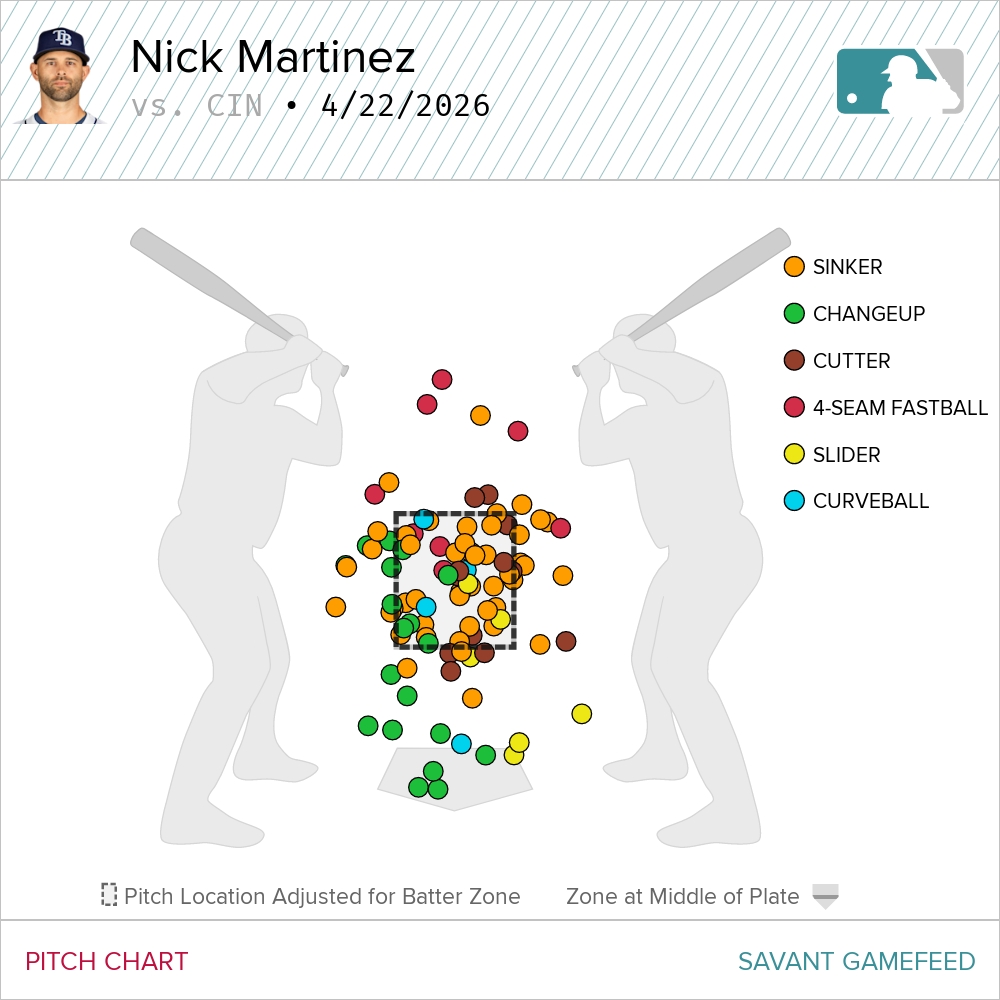
The pitch chart tells the story. Orange everywhere in the zone, green below it. He was sinker-first from pitch one, with a 92 percent first-pitch strike rate on the sinker, and he used the changeup almost exclusively as a chase pitch below the zone. The four-seam, what little he threw, was all elevated, resetting eye level before coming back down. That's a veteran who recognized what he had that day and built a game plan around it in real time.
The Tunnel Works Differently Than I Expected
I wrote below that the sinker is the worst setup pitch for the changeup because they share a similar arm-side trajectory, which dulls the visual deception that normally makes a changeup devastating. The sequencing data from his first four starts backed that up. But the pitch movement chart from today's game complicated the picture. Each cluster on the chart represents a pitch type, plotted by how much it moves horizontally and vertically. Pitches far apart on this chart behave very differently as they reach the plate.
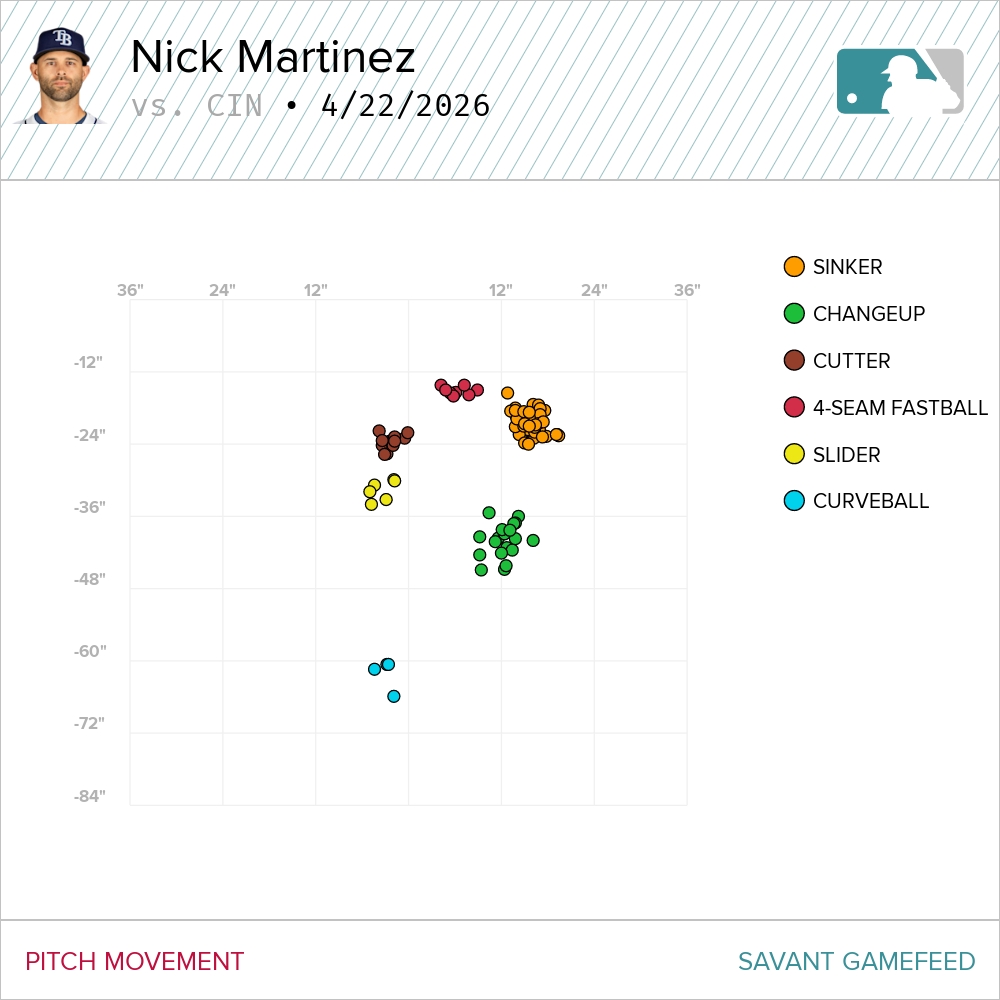
The sinker and changeup do share a similar horizontal plane. Both run arm-side, the sinker at roughly 18 to 24 inches and the changeup at 10 to 18 inches. The horizontal bands overlap, so a batter reading lateral trajectory sees a similar picture for both pitches. But the vertical separation is massive. The changeup drops about 20 inches more than the sinker. The deception isn't happening left-to-right, it's happening up-and-down, and it arrives 14 mph later. By the time a batter recognizes the extra drop, he's already committed to the sinker's plane.
That doesn't erase the sequencing weakness I identified. The changeup whiff rate after a sinker (7.7 percent) is still dramatically lower than after the cutter (23.5 percent) or four-seam (23.1 percent). The horizontal contrast from those pitches still produces a better tunneling effect. But today's movement data suggests the vertical tunnel is doing more work than I gave it credit for. The sinker-changeup pair may not be his best sequence, but it's not as broken as the numbers from four starts made it look.
About That Strand Rate
I said the 2.45 ERA was fake. I need to partially walk that back, or at least sharpen what I mean.
The Reds hard-hit Martinez 8 times today and scored once. That's the strand rate continuing to outperform. But the radial chart from the game showed why: almost every batted ball came off the bat at a low launch angle. No loft. No drives to the gaps. Grounders and liners, pulled to the left side. That's not random sequencing luck. That's what a sinker-heavy, bottom-of-the-zone approach is designed to produce. When 74 percent of your sinkers are in the zone at the knees, batters hit the top of the ball or drive through it. Hard contact turns into ground ball singles and double plays instead of extra-base hits that clear the bases.
The strand rate is still going to come down from 92 percent. No pitcher sustains that. But the regression target might be closer to 78 or 80 percent rather than the league-average 72 percent, because the low launch angles are a feature of the approach, not an accident. That's a hypothesis based on one game's batted ball profile, not a settled number, but the direction is worth tracking. The gap between his ERA and his xERA will narrow, but it may not close completely. I was right that the ERA is too low. I was too aggressive in calling it fake without accounting for what the sinker-first approach does to batted ball profiles.
The Game Plan Was Batter-Specific
The per-batter pitch charts from the Savant gamefeed revealed something the aggregate data couldn't: Martinez tailored his approach to individual hitters rather than running the same sinker-changeup playbook against everyone.
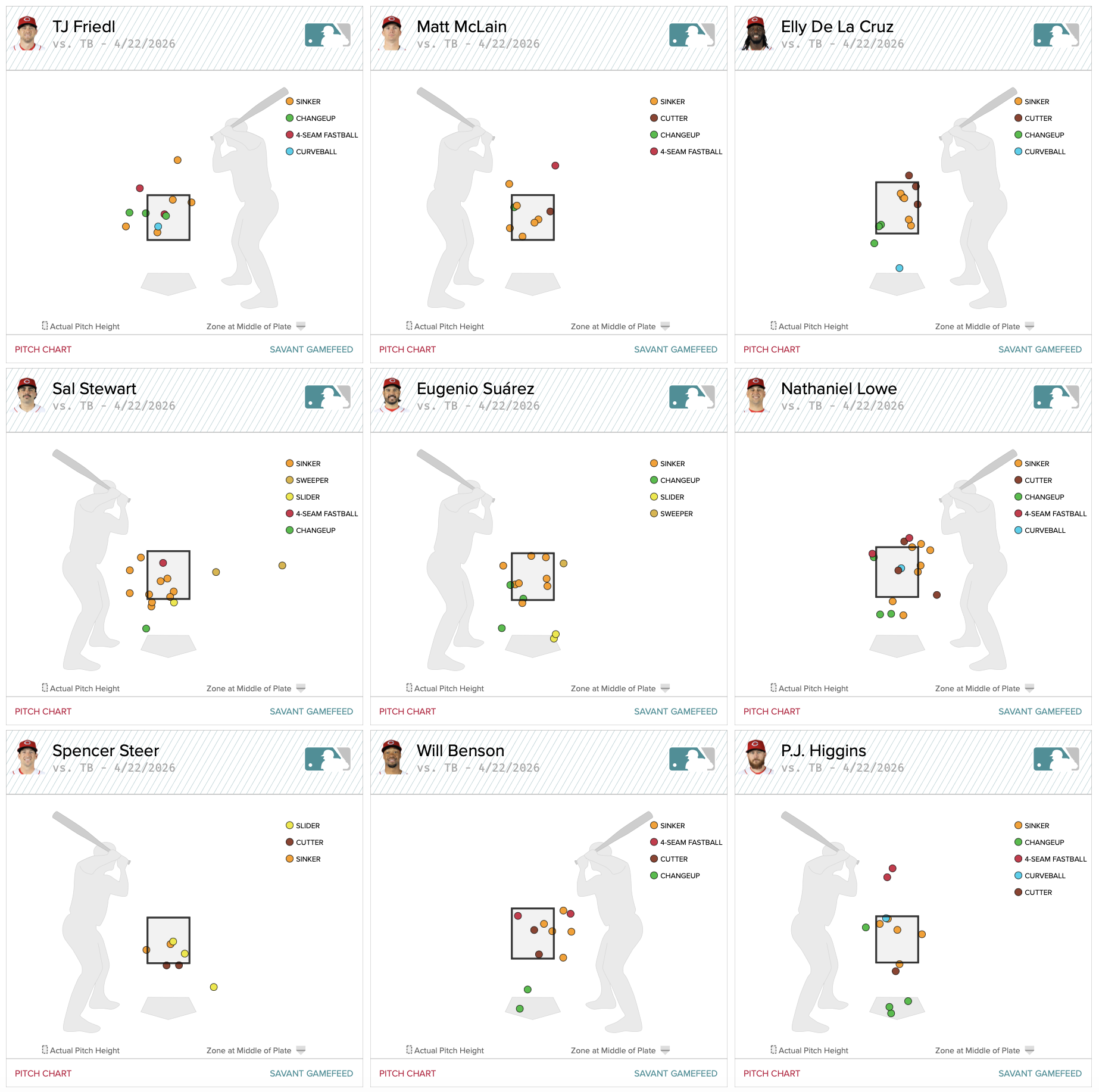
Sal Stewart, the hitter I identified as having the best contact quality to punish the sinker (.426 xwOBA), got the most diverse pitch mix of anyone on the card. Martinez threw him sweepers, sliders, four-seams, sinkers, and a changeup. He opened up the full six-pitch arsenal specifically for Stewart. That's a pitcher going out of his comfort zone because he knows the batter in front of him can hurt him.
Spencer Steer was the surprise. I predicted Martinez would attack his 33.2 percent chase rate with changeups below the zone. Instead, Martinez went slider, cutter, sinker. No changeups at all. He used the slider as the chase pitch instead, which suggests either Steer's changeup recognition is better than his aggregate chase rate implies, or Martinez's game plan accounted for something pitch-type-specific that the overall numbers don't capture. If it's the latter, that's a level of game-planning granularity that a four-start aggregate can't see.
Elly De La Cruz got exactly what I predicted: changeups buried well below the zone, diving away from his left-handed swing. Martinez also mixed in cutters and a curveball, giving Elly more variety than most hitters saw. He respected him without deviating from the core plan.
Martinez used essentially the same template against every left-handed batter: sinkers in the zone, changeups below it, occasional four-seams up to reset eye level.
Rece Hinds, the hitter I flagged as most at-risk with a 40.6 percent chase rate, didn't start.
What This Changes Going Forward
The sequencing weakness is real but probably less exploitable than I made it sound. The vertical tunnel between the sinker and changeup is doing more work than the horizontal analysis captured, and Martinez is smart enough to adjust his chase pitch per batter when the standard changeup setup doesn't apply. The strand rate is still going to regress, but the floor is higher than league average because the low launch angles are built into the approach. And the mechanical change, the lower arm slot, held even on a diminished-stuff day, which makes it more likely this is a permanent adjustment rather than something he's still tinkering with.
His ERA will come up. A 2.10 ERA with a 4.66 xERA is not sustainable under any interpretation of the data. But this isn't a 4.7-ERA pitcher pretending to be a 2.1-ERA pitcher. It's probably a 3.8-to-4.2-ERA pitcher who is executing a well-designed approach and running hot on strand rate. The Reds chased anyway. The next team that sits on the sinker and lays off the changeup will tell us where the floor actually is. For fantasy purposes, the revised ERA range doesn't change the verdict: he's still not rosterable in standard leagues.
▶ TLDR
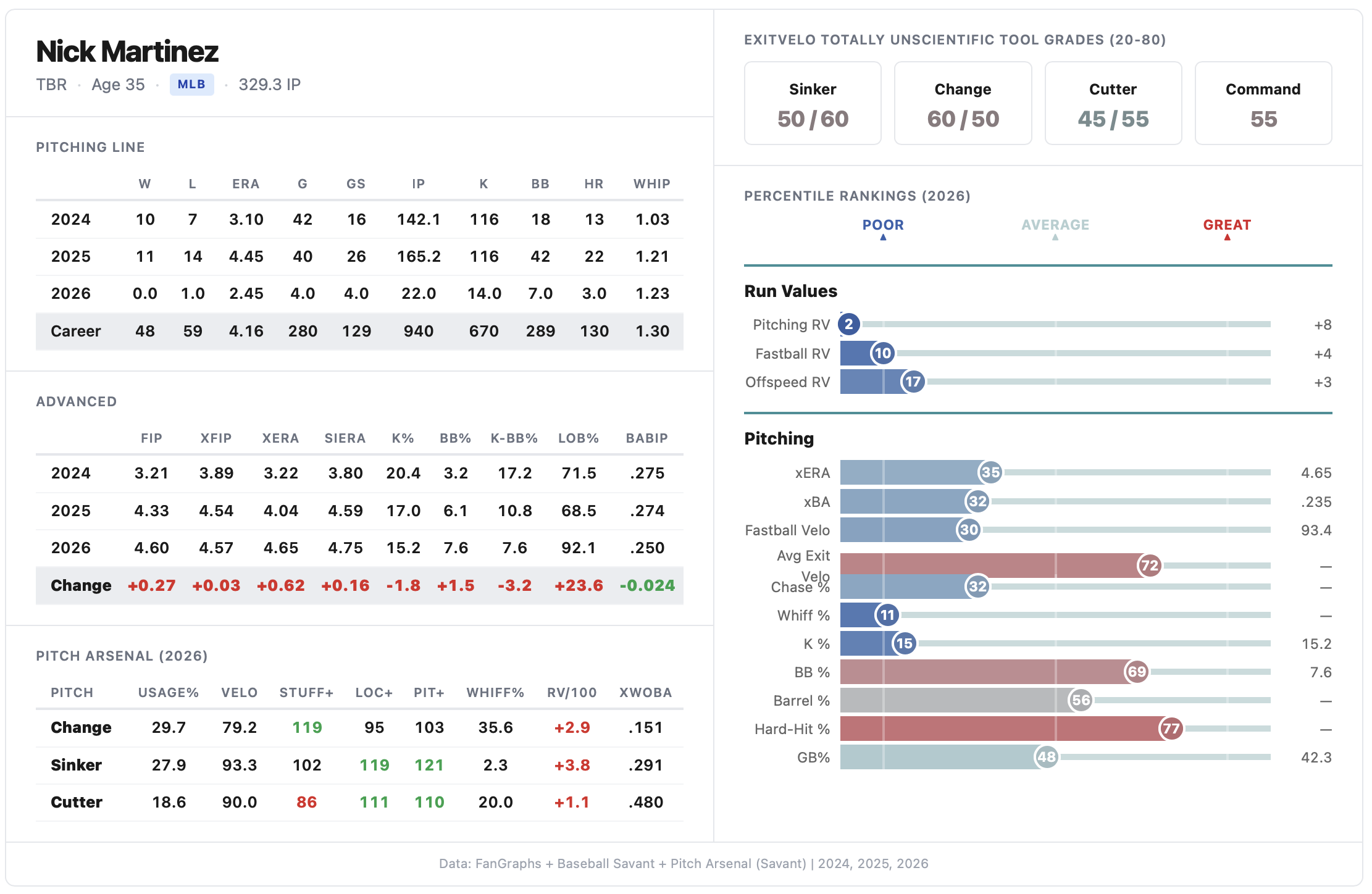
Nick Martinez rebuilt his pitching approach in Tampa Bay. His sinker and changeup now make up 58 percent of his pitches, up from 37 percent in Cincinnati, while the four-seam fastball has nearly disappeared. It's not just a pitch-mix tweak. Pitch-level data shows he changed his release point, his sequencing patterns, and his entire location strategy: the sinker now attacks the zone, while the changeup is buried below it as a chase pitch. His sinker grades have improved each year, but his 2.45 ERA is propped up by an unsustainable 92 percent strand rate. The real ERA is probably closer to 4.5.
If you're new to baseball: A sinker is a fastball that dives down and runs sideways as it reaches the plate, making it hard to lift for home runs. A changeup looks like a fastball leaving the pitcher's hand but arrives about 14 mph slower and drops further, fooling hitters who committed to the faster pitch. Martinez used to throw six different pitches pretty evenly. Now he mostly just throws these two, and he throws them to different spots than he used to.
If you manage a fantasy team: Martinez is not a fantasy-relevant pitcher. His strikeout-minus-walk rate has declined each year (17.2 percent, 10.8 percent, 7.6 percent), his FIP is 4.59, and projection systems see him as a back-end starter. Stream against him if you have Reds bats.
The Nick Martinez who pitched for Cincinnati threw six pitches in roughly equal measure. His four-seam fastball sat at 21 percent usage. His cutter got 21 percent. His changeup, 20 percent. His sinker, 17 percent. The curveball and slider rounded out the back end. Nothing dominated. Nothing disappeared. He was an organized pitcher, the kind of veteran you plugged into the middle of the rotation knowing he'd give you six innings and a chance, and Reds fans respected him for exactly that.
That pitcher doesn't exist anymore.
The Nick Martinez who takes the mound at Tropicana Field tonight has dropped his four-seam to 12 percent and falling. In his most recent start against Pittsburgh, he threw it 4 percent of the time. His sinker jumped from 17 to 28 percent. His changeup went from 20 to 30 percent. Together, those two pitches now account for 58 percent of everything he throws, up from 37 percent last year. The curveball, slider, and four-seam have all been pushed to the margins. He's essentially a two-pitch pitcher now, with the cutter as his third option and everything else as decoration.
Martinez's Pitch Mix — 2025 (CIN) vs. 2026 (TBR)
| Pitch | 2025 | 2026 | Shift |
|---|---|---|---|
| Changeup | 19.8% | 29.7% | ▲ +9.9 |
| Sinker | 17.1% | 28.2% | ▲ +11.1 |
| Cutter | 21.2% | 18.3% | -2.9 |
| Four-Seam | 20.7% | 11.9% | ▼ -8.8 |
| Curveball | 11.0% | 7.3% | ▼ -3.7 |
| Slider | 10.2% | 4.7% | ▼ -5.5 |
Data: FanGraphs Statcast pitch tracking, 2025–2026. 2026 sample: 345 pitches across 4 starts.
I pulled all 345 pitches Martinez has thrown this season and compared them against all 2,582 from his 2025 Reds season. What I found isn't just a pitch-mix adjustment. He's changed his sequencing, his location strategy, and even where the ball leaves his hand. This is a full rebuild.
The Sequencing Problem
The most interesting part, for Reds fans watching tonight, is that the rebuild has a structural weakness your lineup might be able to exploit.
In Cincinnati, Martinez's most common pitch sequence was changeup-to-four-seam. After a changeup in 2025, he went to the four-seam 29 percent of the time, to the cutter 27 percent. The four-seam served as a visual contrast: it moved straight relative to the changeup's arm-side dive, so batters who adjusted their eye to the changeup's lateral movement were vulnerable to the four-seam coming in on a different plane. The changeup's whiff rate after a four-seam was 14.9 percent, barely above its 14.5 percent overall average. After the cutter, 16.3 percent. These were modest but functional setup combinations.
In Tampa, the sinker replaced the four-seam in that role. After a changeup in 2026, 36 percent of the time the next pitch is the sinker. After a sinker, 37 percent of the time it's the changeup. The sinker-changeup loop is now his primary sequencing pattern, making up over 21 percent of all consecutive pitch pairs, compared to 11 percent for his top-2 sequences in 2025.
Here's the problem: the sinker is the worst setup pitch for the changeup in his entire arsenal, and it has been for two years. In 2025, his changeup whiff rate dropped by 2.8 percentage points when it followed a sinker, from 14.5 percent overall to 11.7 percent. In 2026, the gap has widened. The changeup whiff rate after a sinker is 7.7 percent, a full 8 points below its overall 15.7 percent average.
Compare that to what happens when the changeup follows the cutter or four-seam. After the cutter, the changeup's whiff rate jumps to 23.5 percent. After the four-seam, 23.1 percent. After the curveball, 27.3 percent.
Changeup Whiff Rate by Setup Pitch — 2026
| Pitch Before CH | Pairs | CH Whiff% | vs. Avg (15.7%) |
|---|---|---|---|
| Curveball | 11 | 27.3% | +11.6 |
| Cutter | 17 | 23.5% | +7.8 |
| Four-Seam | 13 | 23.1% | +7.4 |
| Changeup | 18 | 16.7% | +1.0 |
| Sinker | 26 | 7.7% | -8.0 |
Data: Statcast pitch-level data, 2026 season (345 pitches, 253 consecutive pairs). Overall changeup whiff rate: 15.7%.
The sinker and changeup both run arm-side, roughly -14.7 and -12.5 inches of horizontal movement respectively. When a batter has just tracked a sinker diving in on his hands, his eye is already calibrated to that lateral plane. The changeup, arriving on a similar trajectory but 14 mph slower, doesn't create the same visual deception as it would after a pitch with straight or glove-side movement. The speed difference alone can still fool a hitter, but the movement contrast that normally makes the changeup devastating is dulled.
He's running his best strikeout pitch off its worst setup, 10 percent of the time, because the sinker is now his primary fastball. If Reds hitters can recognize that sinker-changeup loop and stop chasing the second pitch, the sequence loses its teeth.
What he gained in exchange is a better sinker. The improvement is real and it's been building for three years. Stuff+, the model that grades raw pitch quality based on velocity, movement, and spin, has his sinker at 101.9, up from 89.6 in 2024 and 97.0 in 2025. Location+, the command grade, jumped to 118.7, a career best on any of his fastball variants. Pitching+, which combines stuff and location into a single grade, sits at 121.3 for the sinker. That's the highest mark on any individual pitch in his arsenal across all three seasons I examined. These are model-based numbers, not results-based, so they stabilize almost immediately and can be trusted even in 22 innings.
Part of what's driving it is a mechanical change. His release point dropped from 6.18 feet to 6.08 feet and moved further arm-side, from -1.55 to -1.72 feet. A lower, more arm-side release gives a sinker more horizontal run and more downward plane, and that's exactly what the movement data shows: his sinker gained nearly 1.7 inches of horizontal movement and lost 1.8 inches of vertical break compared to last year. More run, more sink. The pitch is physically different. Four starts is a small window to call this a settled mechanical change, but the direction is consistent across all four outings and aligns with the sinker's three-year Stuff+ trend.
But the most significant change, the one I didn't see until I compared the location data pitch by pitch, is where he's throwing the two pitches.
In 2025 with the Reds, Martinez threw his sinker and changeup to roughly the same horizontal location, both aimed arm-side of center, inside to right-handed batters. The sinker was up in the zone, the changeup was lower, but they were aimed at a similar left-right spot.
In 2026, he's split them apart. The sinker moved to the center of the plate and climbed slightly. His sinker in-zone rate went from 56 to 65 percent. He's not nibbling anymore. He's challenging hitters with the sinker, throwing it where they can see it, daring them to put it in play.
The changeup went the opposite direction, moving further arm-side and dropping lower. His changeup in-zone rate fell from 48 percent to 29 percent. The below-zone rate, the chase territory, jumped from 40 percent to 60 percent.
He has given each pitch a role. The sinker is the zone-attack pitch, designed to generate called strikes, weak contact, and ground balls. The changeup is the chase pitch, buried below the zone, designed to get swings at air. In 2025, both pitches worked from the same general area and he mixed them for deception. Now they're strategically separated, aimed at different parts of the batter's decision framework.
That's a redesign, not a guy who just decided to throw more sinkers. But a redesign that puts 65 percent of your sinkers in the strike zone is also one that gives hitters something to hit if they're looking for it early in counts.
About That 2.45 ERA
It's fake. I should be clear about this because the box score will show a guy with a 2.45 ERA and Reds fans might wonder what happened to the pitcher who posted a 4.45 ERA last year. What happened is he's stranded 92 percent of his baserunners, which is roughly 20 points above where any pitcher can sustain for a full season. League average is about 72 percent. His FIP is 4.59. His xERA is 4.65. His xFIP is 4.56. His SIERA, another ERA estimator that weighs strikeout and walk rates heavily, is 4.74. Five independent estimators converge around 4.5 to 5.0. The ERA is going to come up, and probably sharply, once the strand rate normalizes. The Reds can accelerate that tonight by stringing hits together and putting pressure on him with runners on, because the strand rate says he hasn't been tested with traffic yet and every estimator says the results will look different when he is.
His strikeout-minus-walk rate, the single best efficiency metric for pitchers, has declined every year: 17.2 percent in 2024, 10.8 percent in 2025, 7.6 percent in 2026. The walks are up. The strikeouts are down. The 2024 version of Martinez in Cincinnati, the one who posted a 3.10 ERA with a 3.21 FIP and walked 3.2 percent of batters, was a legitimately good starting pitcher. The 2026 version is not that pitcher. He's a back-end starter with an upgraded sinker, an elite-stuff changeup, and a sequencing plan that has a known weakness.
What to Watch Tonight
So what should you look for tonight?
The Reds send a predominantly right-handed lineup to the plate. Stewart, McLain, Suárez, Steer, Stephenson, Hayes, and Hinds all bat right-handed. Against Martinez's sinker, they'll see the ball running in on their hands at 93 mph. Against the changeup, they'll see something on a similar arm-side trajectory that drops below the zone and arrives at 79. The sinker says "swing." The changeup says "miss."
The Reds hitters most at risk are the ones who chase. Rece Hinds's chase rate is 40.6 percent this season, the highest on the team. Spencer Steer is at 33.2 percent. TJ Friedl, who bats left-handed and will see the changeup diving away from him rather than into him, is still chasing at 31.3 percent. Will Benson, 30.1 percent. Martinez will bury that changeup below the zone to anyone who expands, and those four are expanding more than most.
Elly De La Cruz is the most interesting matchup on the card. He's a switch-hitter, so he'll bat left-handed against the right-handed Martinez. From the left side, the sinker runs away from him rather than in on his hands, which is theoretically easier to handle. But De La Cruz has a 27.9 percent chase rate of his own this year with a 70.1 percent contact rate, and the changeup diving further away from a left-handed batter's barrel is still a tough take when it starts in the zone and drops out of it.
The opportunity for the Reds is the sinker in the zone. Martinez is throwing it there on purpose, challenging hitters, and his sinker whiff rate is 2.3 percent across 96 pitches, a sample too small to trust as a settled number but directionally consistent with what sinkers do. Batters are not missing it. They're putting it in play. His ground-ball rate has climbed to 42 percent, but when the sinker catches too much plate, the xwOBA against it is .291. That's hittable. Sal Stewart, who's carrying a .426 xwOBA this season, and De La Cruz, who is averaging 95.5 mph exit velocity, are the two Reds hitters with the contact quality to punish a sinker left over the plate. The approach for the Reds tonight should be straightforward: lay off the changeup below the zone, sit on the sinker over the plate, and drive it before the count gets deep enough for him to go to his putaway pitch. Easier said than done with a 119 Stuff+ changeup diving at your knees, but that's the game plan.
There's something faintly Rays-ish about the whole thing. Tampa Bay has a long history of taking pitchers other teams have let go and reshaping them into something more efficient, stripping away the parts that don't work and leaning harder into the parts that do. Martinez fits the archetype. He arrived as a six-pitch veteran and they're turning him into a two-pitch specialist, the same way a guitar tech might strip a Telecaster down to just the bridge pickup because that's the one that sounds right.
The Reds fans who liked Martinez, and there were a lot of you, will recognize the competitor. The delivery still looks the same from the stands. The same measured pace, the same professional bearing, the same guy who gave you everything he had every five days and never made excuses when it wasn't enough.
But if you're watching the pitches, and not just the pitcher, you'll notice that the four-seam you used to see 20 percent of the time barely shows up. You'll notice the sinker running in on your right-handed hitters with more life than it had last year. You'll notice the changeup diving below the zone more often than it did when he wore red, because he's not trying to throw it for strikes anymore.
The number to watch is the sinker in-zone rate. If it stays above 60 percent, he's executing the new plan and the Reds will need to punish it early in counts before the changeup takes over. If it dips below 50 percent, his command is drifting and the walks will follow. His walk rate has already climbed from 3.2 to 7.6 percent across three seasons. The margin between the 2024 version and the 2026 version is command, and command is what he's betting his reinvention on.