
▶ TLDR
Elly De La Cruz's 2026 season (148 wRC+, .399 wOBA through 108 plate appearances) is his best yet, surpassing even his 6.6-WAR 2024. The popular explanation focuses on his chase rate, which is at a career low. That's real, but it's part of a bigger picture. Baseball Savant's batter positioning data shows he rebuilt his stance over the offseason: 3.5 inches closer to the plate, 6.6 inches wider, 19 degrees more closed from the left side. His swing length has shortened every year since his debut. His squared-up contact rate has improved every year. The stance change gave those mechanical gains a better foundation, and a more patient approach gave the new stance pitches worth hitting. The payoff: exit velocity up 4.5 mph, barrel rate doubled, topped-ball rate below league average for the first time. The open question is whether the discipline outcomes (strikeout rate actually went up, walk rate flat) will eventually catch up, or whether a persistent curveball vulnerability caps the improvement.
If you're new to baseball: When a hitter stands too far from the plate, he has to lunge to reach pitches on the outside corner, which means committing to a swing before he knows where the ball is going. De La Cruz moved closer this year and became more selective about which pitches to swing at. Together, those two changes have transformed his contact quality.
The short version: Elly changed where he stands and how he picks his pitches. Neither works without the other. The 2026 version is the best he's been.
If you manage a fantasy team: The contact quality gains are real and backed by multi-year mechanical trends, but expect regression from the 54-HR pace to something closer to 30 to 35 home runs. His true talent is probably between the ZiPS projection of 122 wRC+ and his current 148, depending on whether the curveball vulnerability improves. Watch the strikeout rate: if it drops below 26 percent by June, buy more aggressively.
Elly De La Cruz was already a star. In 2024, his second full season, he put up 6.6 WAR with 25 home runs, 67 stolen bases, and a 119 wRC+. He was 22 years old, 6-foot-6, a switch-hitting shortstop with 75 mph bat speed and sprint speed at the 100th percentile. The tools were generational. The production was catching up to them.
Then 2025 happened. A quad injury cost him time and, I think, cost him his stance. His wRC+ dropped to 109. His exit velocity fell from 91.8 to 91.0 mph. His barrel rate slid from 12.7 to 10.2 percent. He was still a useful player, but the 2024 version felt like it had stalled.
Through 24 games in 2026, the old Elly is back, and it brought a friend. He's hitting .276/.343/.571 with eight home runs and a 148 wRC+. His exit velocity has jumped to 95.5 mph, 99th percentile in the majors, and his expected weighted on-base average is .393. Suffice it to say, this isn't simply a return to 2024. It's a step forward.
The popular narrative with Elly was that he was a whiffy power hitter who chases. So any explanation of why he's improving logically starts with his discipline. His chase rate has dropped to 24.1 percent according to Baseball Savant (FanGraphs measures it at 27.8 percent, same direction, different zone boundary). That's below the league average of 28.5 percent and his best mark in three big league seasons. That's a real improvement, and it's definitely part of the story.
But improved discipline alone doesn't explain his contact quality explosion. I went looking for what else changed, and I found it in the batter positioning tool on Savant.
The 2026 Batter's Box
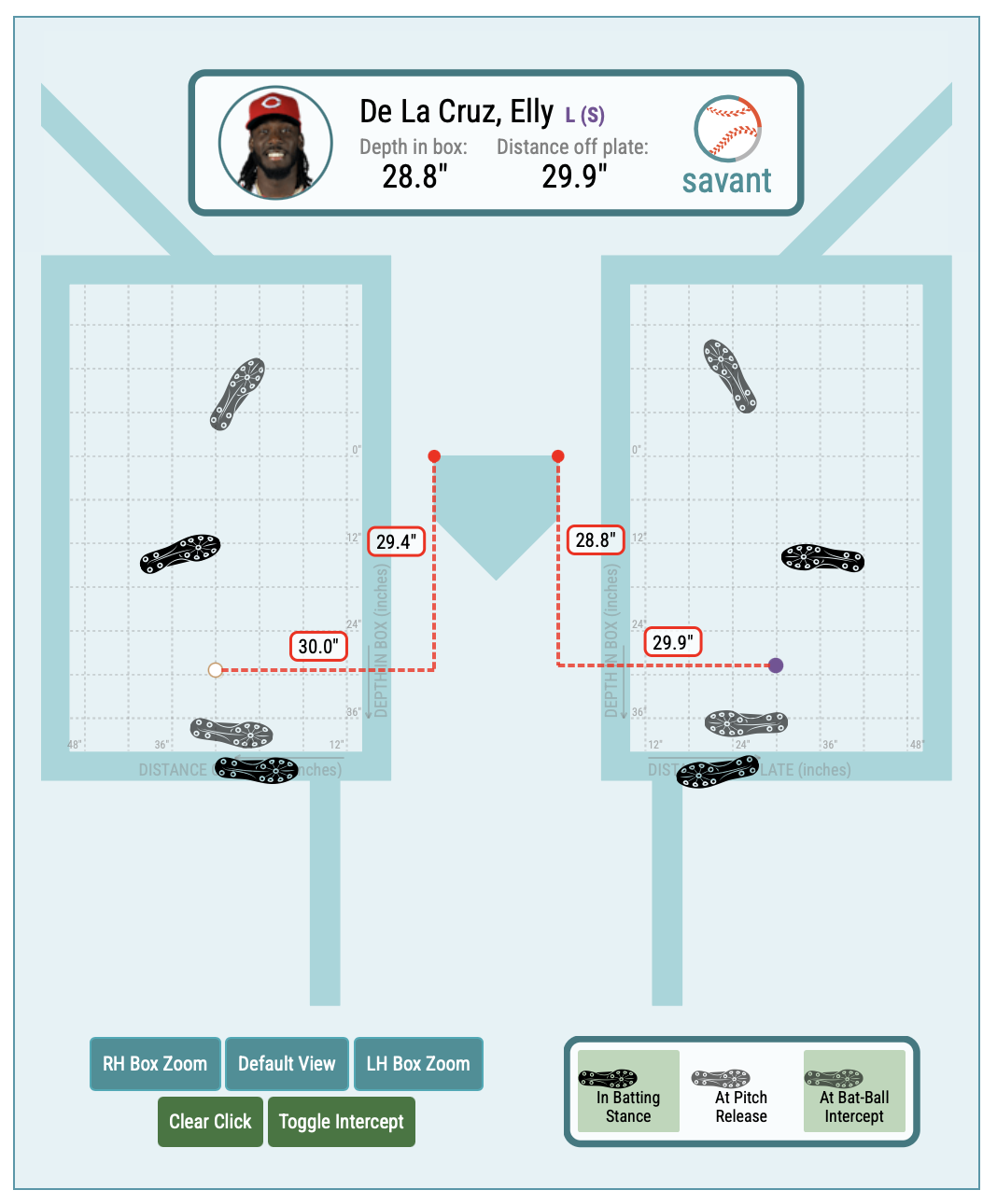
The year-over-year changes in a hitter's box position are usually measured in fractions of an inch. Elly's changes from the left side of the plate (where he stands against right-handed pitchers and the majority of his plate appearances) might as well be measured in miles. This is clear in his Savant stance numbers: how deep his is in the box, how far he is from the plate, how wide his stance is, and the angle of his feet before, during, and after a pitch.
Elly De La Cruz — Left-Side Batter's Box Position
| Measurement | 2024 | 2025 | 2026 | Change |
|---|---|---|---|---|
| Depth in box | 27.5" | 28.8" | 27.7" | -1.1" |
| Distance off plate | 29.8" | 29.9" | 26.4" | -3.5" |
| Stance width | 32.4" | 30.8" | 37.4" | +6.6" |
| Stance angle | 13° open | 29° open | 10° open | -19° |
Source: Baseball Savant batter positioning tool, 2024–2026. Left-side measurements (batting against right-handed pitchers). Green rows highlight the largest year-over-year changes.
2025
2026
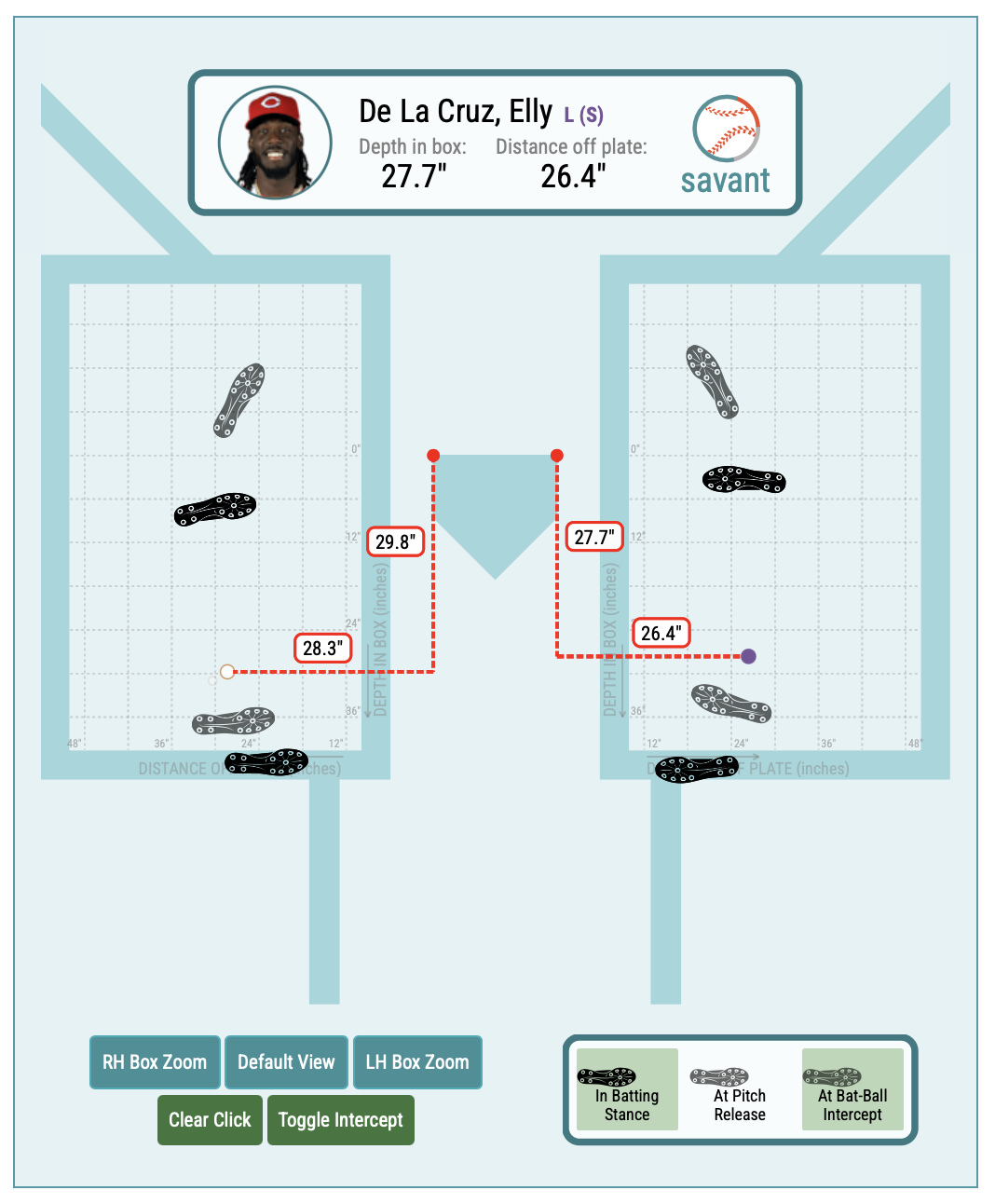
In 2026, he moved 3.5 inches closer to the plate, widened his base by 6.6 inches, and significantly closed his stance angle from 29 degrees open to 10 degrees. The right-side adjustments are directionally identical (1.7 inches closer, 2.7 inches wider, 9 degrees more closed) but smaller in magnitude.
Interestingly, this marks a return to the what his stance looked like in 2024. In that context his 2025 stance was the outlier, and the quad injury may explain why. In 2025, his stance was extremely open, narrow, and set back from the plate. That's the kind of setup a hitter drifts into when he's protecting a lower-half injury, limiting weight transfer and rotation to avoid loading the quad. It produces a long swing path, a lot of head movement, and limited reach on the outer third. Not coincidentally, this produced his worst contact quality season so far on his career: his average exit velocity fell to 91.0 mph, his barrel rate to 10.2 percent, and more than a third of his batted balls were topped for weak grounders.
As I said, the 2026 stance returns him to geometry closer to 2024, which was his best full season at 6.6 WAR. The big difference is that Elly's standing closer to the plate than ever before. Look at it like this: when I used to tend bar, I couldn't reach the bottles on the top shelf if I was standing too far back. The reach problem wasn't my arm length; it was where my feet were. Elly's 2025 setup put him too far from the plate to cover the outer edge without lunging, and lunging meant committing to a swing earlier, which meant chasing breaking balls he couldn't reach cleanly.
Now he's standing close enough that the shadow zone, where he'd been a career-negative hitter to the tune of 42 runs, is more easily within his natural reach. Savant tracks batting run value by zone, and his shadow zone performance improved from -11 runs in 2025 to -4 in 2026. In the heart of the zone, he flipped from -10 runs to +6. He's not doing damage because he's seeing more hittable pitches. He's doing damage because he can physically reach more of the zone. And we all know what he can do when he reach a ball cleanly.
What the Shorter Swing Produces
Elly's stance change accelerated a mechanical evolution that's been building since his MLB debut in 2023. Every season his swing has gotten shorter. Every season his squared-up contact has improved. The four-year progression is the most reliable trend in his data, built on over 2,700 competitive swings.
Elly De La Cruz — Swing Length Progression
Speed 76.7 mph
Squared-up 25.1%
Speed 75.2 mph
Squared-up 31.7%
Speed 74.5 mph
Squared-up 34.4%
Speed 75.0 mph
Squared-up 38.1%
Swing length shortened every year while bat speed held steady. Squared-up contact rate is the percentage of swings where the barrel's sweet spot meets the ball. Source: FanGraphs bat tracking, 2023–2026.
Elly's swing shortened almost half a foot over three years while bat speed barely moved. So he's not just trading more power for less contact. He's finding a more efficient path to the ball with the same rotational force behind it. This shows up in his blast rate, the hardest-hit subset of squared-up balls, which nearly doubled from 16.5 to 26.5 percent.
Those mechanical changes show up in other places in the Statcast data, too. His 90th-percentile exit velocity hit a career-best 110.0 mph. His barrel rate doubled from 10.2 to 16.4 percent (91st percentile). His topped-ball rate, which leads to weak contact, dropped from 38.3 to 29.9 percent, which us below the league average for the first time in his career. Overall weak contact fell to 1.5 percent, almost nothing. His launch angle rose from 7.6 to 13.6 degrees.
Here's the part that surprised me. Despite all this good contact and power, his max exit velocity actually declined from 117.4 to 112.2 mph so far this season. He's not swinging harder than he ever has. He's swinging more consistently. What used to be topped grounders to short are now line drives and barrels. That's the signature of a mechanical adjustment.
I should flag the obvious: 108 plate appearances and roughly 67 batted balls is a small sample. Exit velocity and barrel rate are past their stabilization thresholds (they become trustworthy around 40 batted ball events), but a 4.5 mph jump in one offseason is historically extreme and some regression toward 92 or 93 mph is the reasonable expectation. But even there, that would still be a career year for Elly. And his HR/FB rate of 33.3 percent, eight home runs on about 24 fly balls, will most definitely regress (his career rate is 18.8 percent, and league average is around 11). The 54-HR pace probably isn't real, but the contact quality powering it is.
The discipline improvement and the stance change reinforce each other, and neither one works alone. A patient hitter standing too far from the plate still can't cover the outer half. An aggressive hitter standing close still chases. Elly changed both.
According to Savant, his chase rate dropped from 28.5 to 24.1 percent, and his swinging strike rate fell to 12.0 percent, another career best. His zone contact rate rose to 82.9 percent, another metric that's above the league average for the first time in his career. And he's hitting the four-seam fastball better than ever. His whiff rate on that pitch dropped from 31.7 to 14.1 percent.
That last number is where the stance and the approach connect. A shorter swing means less time committed before the barrel reaches the zone. He has more time to read the pitch, and fastballs he used to miss are getting barreled. The stance created the physical conditions for better contact, and the more patient approach put him in positions to exploit it.
What the discipline numbers don't show yet is the full payoff in traditional outcomes. His strikeout rate rose from 25.9 to 28.7 percent. His walk rate didn't move. His called strike rate spiked from 17.1 to 20.3 percent, meaning he's watching more pitches go by for strikes. His in-zone swing rate dropped from 64.1 to 57.2 percent, well below the league average of 67.0. He's swinging less at everything, including hittable pitches. That's a deliberate approach change, not just a mechanical side effect. His first-pitch swing rate dropped from 37.9 to 27.8 percent, and that kind of patience is a decision, not geometry.
My initial read on Elly's new passivity was pessimistic. It looked like he was leaving value on the table by passing on pitches over the middle of the plate. A lot of fans in the group chats I'm in criticized him for laying off good pitches or, worse, not being clutch. But a look at the zone-based run value data changed my mind. Despite swinging at fewer heart-of-the-zone pitches (61.5 percent, down from 68.6), his heart-zone run value flipped from -10 to +6 runs. He's making fewer swings and doing more damage per swing. He's hunting specific pitches, and when he finds them, the stance and the approach do the rest. Time will tell if this selectivity will pay off, and even more time is needed to see if he shakes the "Elly isn't clutch" accusations.
The gap between the discipline process and the discipline outcomes is the tension the Elly will be resloving for the rest of the season. His chase rate percentile is 78th in the bigs. His whiff rate is 20th. His strikeout rate is 21st. The process says he's choosing better pitches. The outcomes say he's still getting beaten by pitches with break.
Curveballs are the thing that can still hurt him. His K rate against curveballs is 66.7 percent through 12 plate appearances, with a 45.8 percent whiff rate and a .150 wOBA against. Sweepers are worse: 83.3 percent whiff rate on 23 pitches. Splitters too, at 61.5 percent. Pitches with sharp vertical break account for about a quarter of what he sees and the majority of his strikeouts. Opposing staffs have noticed. They're throwing him curveballs at 13.8 percent this year, up from 12.0 percent in 2025 and 10.2 for his career.
His updated stance is helping him cover the horizontal plane. Like I said, he's closer to the plate, so the outer-edge slider is in reach. But curveballs exploit vertical movement, the 12-to-6 drop that beats a swing plane regardless of where the hitter is standing. That vulnerability may be structural, something baked into his bat path that positioning can't solve. Elly's a big dude that needs to cover a lot of space due to his height.
Or it could be the next thing he figures out.
61 curveballs is a hypothesis, not a verdict. But the curveball has been his worst pitch type in every MLB season he's played, across over 400 curveballs, and the stance change doesn't address the axis where it beats him. He'll need to make another adjustment to address this. That kind of progress isn't baked in, but I'm optimistic.
The number I'm watching over the next 100 plate appearances is the strikeout rate. If it drifts down toward 26 percent while the chase rate holds below 26, that's the process pulling the outcomes along, and the adjustment is maturing. If the K rate stays above 28 percent and the whiff rates on breaking balls don't improve, the curveball ceiling is likely real and his true talent is closer to the ZiPS projection of 122 wRC+ than the 148 he's posting now.
Once again, either number would be a career year. He was already a star before the quad, before the stance drifted, before the 2025 regression. What's different about the 2026 version is that the stance and the approach finally match. He fixed where he stands, he fixed how he picks his pitches, and the best version of Elly De La Cruz is the one where both of those things are working at once.
A lot of people consider 2024 to be Elly's breakout season, but I think 2026 could be the real deal.
The Bat Path, One Day Later
After I published this piece, I went back and pulled Elly's attack angle data across all four of his MLB seasons. I wanted to see whether the swing plane itself had changed, or whether the stance was doing all the work. The answer is both, and the split between them tells a more interesting story than I expected.
His overall attack angle in 2026 is 9.6 degrees, exactly what it was in 2024. In 2025, it dipped to 8.3 degrees, consistent with the flat, injury-protecting stance I described above. So the swing plane recovered, but it didn't leap forward. And yet his launch angle jumped to 13.6 degrees, a career high by nearly four degrees over 2024. That gap, where the bat is meeting the ball at the same angle but producing significantly more loft, is the stance doing its job (small sample alert!). A wider base and a closer setup create better contact geometry at the point of impact, even without a steeper swing. The stance is generating the extra loft, coupled with bat path.
Elly De La Cruz — Attack Angle vs. Launch Angle, 2023–2026
| Metric | 2023 | 2024 | 2025 | 2026 |
|---|---|---|---|---|
| Attack Angle | 6.3° | 9.6° | 8.3° | 9.6° |
| Launch Angle | 3.6° | 9.7° | 7.6° | 13.6° |
| Tilt | 36.4° | 35.2° | 33.7° | 33.8° |
| Swing Length | 7.41 ft | 7.28 ft | 7.19 ft | 6.97 ft |
| Bat Speed | 76.7 mph | 75.2 mph | 74.5 mph | 75.0 mph |
Source: FanGraphs bat tracking data, 2023–2026. Attack angle = average angle of the bat path through the hitting zone. Launch angle = average angle of the ball off the bat. Tilt = angle of the bat at contact, where lower values indicate a more level bat.
The tilt number quietly confirms this. His bat tilt has been steadily declining since his debut: 36.4 degrees in 2023, down to 33.8 in 2026. A lower tilt means the bat is more level at the point of contact, which creates a wider margin for squaring the ball up. Combined with the shorter swing (6.97 ft, another career low), the bat is spending more time in the hitting zone and arriving there on a flatter plane. That's the mechanical explanation for why his squared-up contact rate has climbed every single year.
His bat tilt dropped three to four degrees against almost every pitch type in 2026. Against fastballs, 39.3 to 37.8 degrees. Against changeups, 34.8 to 30.9. Against cutters, 37.2 to 33.6. A more level bat at contact means the barrel stays in the hitting zone longer, and the timing window widens. That's consistent with the shorter swing, the improved squared-up rates, and the fewer topped balls.
The curveball tilt is where it gets uncomfortable for the optimistic read. In the article above, I framed the curveball vulnerability as potentially structural but left the door open: maybe he figures it out. His curveball-specific tilt dropped from 44.0 to 40.1 degrees, the largest single-pitch-type change in either direction. He's making more level contact against curveballs. But a more level bat is exactly the wrong adjustment against a pitch with sharp 12-to-6 vertical drop. A curveball falling through the zone wants to meet a bat that's angled to catch it on the way down, not one that's leveling out. The tilt data doesn't complicate my original framing. It reinforces it. The bat is getting flatter against a pitch that punishes flat bats, and the results reflect it: 66.7 percent K rate, 45.8 percent whiff rate on 12 plate appearances.
The sweeper tilt went the opposite direction from every other pitch type, rising from 30.3 to 36.5 degrees. He's tilting more against a pitch whose primary movement is horizontal sweep, unlike the curveballs and splitters that beat him with vertical drop, and the 83.3 percent whiff rate on 23 pitches reflects it. That's two different pitches exploiting two different mechanical mismatches, and neither one has been addressed by the changes that fixed everything else. Fix that, and he'll unlock another level.
So the overall mechanical progression is good news, and it's the most reliable trend in the data. His tilt has flattened every year, his swing has shortened every year, his attack angle recovered to its 2024 peak, and his launch angle blew past it to a career high. That last gap is the telling one: the swing plane only returned to where it was, but the launch angle jumped nearly four degrees beyond it. The stance and the flatter bat are generating loft the swing path alone can't explain. Four years of convergent mechanical trends, built on over 2,700 competitive swings, is the kind of trajectory you can build a projection around. But the same flattening that produces barrels on heaters produces whiffs on hooks, and that tradeoff is harder to solve than I thought yesterday.
Update added April 24, 2026. Original article above is unedited.