
▶ TLDR
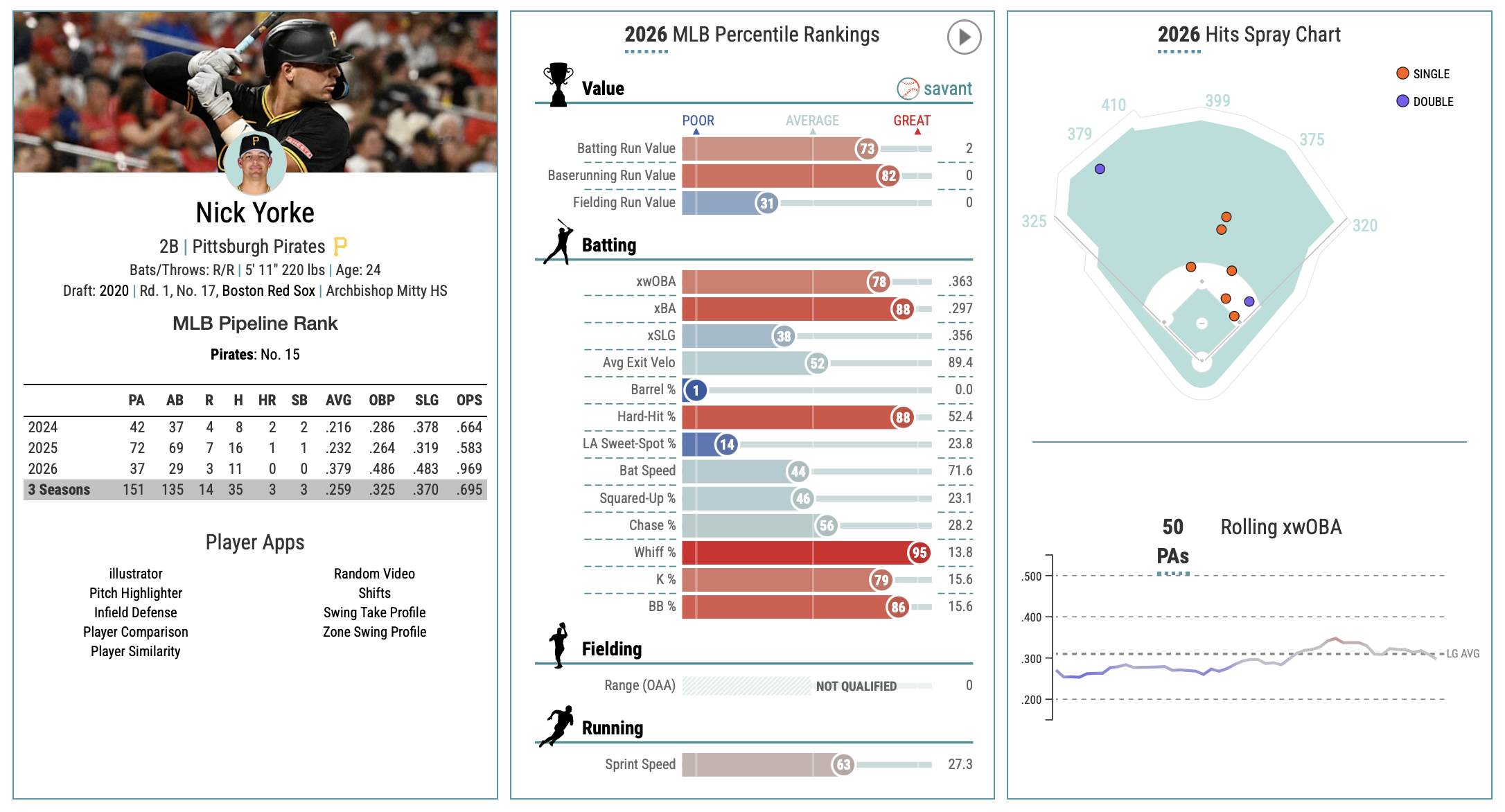
Nick Yorke's bat speed hasn't changed across three MLB call-ups (71.8, 71.9, 71.9 mph), but the consistency of his swings has. The standard deviation of his bat speed dropped from 4.78 to 3.42 mph as he stopped overswinging and started trusting his natural speed band. The result is a recovered exit velocity of 90.0 mph, career-best contact rates, and a strikeout rate that has dropped at every call-up (28.6, 20.8, 14.3 percent). The catch: zero barrels, zero home runs, and a 1.8-degree attack angle that's working against his power output.
The number to track: If his bat speed standard deviation stays in the low 3s, the approach is holding. If it drifts back toward 4.5, the pressing is coming back.
If you're new to baseball: Bat speed tells you how fast a hitter swings. But two hitters with the same average bat speed can look completely different at the plate if one swings at a steady speed and the other alternates between tentative check-swings and max-effort hacks. Yorke was the second type in his debut and has become the first. He's not swinging harder. He's swinging the same way more often, and that consistency is producing better contact with less effort. Think of it like a golfer who stops trying to crush every drive and instead swings smoothly at 80 percent, and finds the ball goes just as far with more accuracy.
If you manage a fantasy team: Yorke is not rosterable in standard leagues right now. He's a utility player behind Triolo, Gonzales, and Griffin on the Pirates' depth chart, with no clear path to everyday at-bats. The batting average is inflated (.381 with a .444 BABIP), and the zero home runs with a 1.8-degree attack angle cap his counting-stat ceiling. In deeper leagues or NL-only formats, he's a speculative bench bat worth monitoring if the attack angle steepens or if injuries open a regular role. The contact gains and strikeout trend are real, but the playing time isn't there yet. Check back in June.
71.8 miles per hour.
71.9 miles per hour.
71.9 miles per hour.
That's Nick Yorke's average bat speed across three MLB stints: his September 2024 debut, his September 2025 call-up, and his 2026 Opening Day roster. Three different versions of the same hitter, three different sets of results, and the bat is moving at functionally the same speed every time.
In 2024, he struck out 28.6 percent of the time. In 2025, the strikeouts dropped to 20.8 percent. In 2026, through just 28 plate appearances, he's hitting .381 with a 178 wRC+ and a strikeout rate of 14.3 percent. The results will regress, but the direction won't surprise anyone who's looked at his swings.
Same bat speed. Completely different outcomes. The explanation lives in a number that most of us have never thought to look at: not how fast he swings, but how consistently.
The Distribution
FanGraphs reports bat speed as a single average. That's useful the same way reporting a city's average temperature is useful: it tells you something, but not what it's like to stand outside. Two cities can average 70 degrees and feel completely different if one is dry and the other is humid. The number is the same, but the experience isn't.
The Statcast pitch-level data lets us look underneath that average. Every swing gets its own bat speed measurement. And when I pulled Yorke's individual swing data from all three MLB stints (232 total swings) the story wasn't in the middle of the distribution. It was at the extremes: the slowest swings and the fastest ones.
In September 2024, his first time in the big leagues, 10.4 percent of his swings came in under 65 mph. This is the kind of bat speed a hitter produces when he's bailing out, checking his swing, or flinching at something he wasn't ready for. And on the other end, 32.8 percent of his swings reached 75 mph or higher, which is the fast-swing rate threshold. Only 31.3 percent of his swings were in the 70-to-75 range, the band that represents his natural swing speed.
The bat speed distribution of his swings that month had a standard deviation of 4.78 mph. The league median is roughly 3.7, which put Yorke in the 91st percentile of swing volatility. He was swinging like a hitter who couldn't commit to a swing decision.
By 2025, the distribution tightened. The under-65 group shrank to 1.7 percent, and the over-75 group dropped from 32.8 to 20.7 percent. The 70-to-75 bucket, his natural speed, grew to 51.2 percent of all swings, with a standard deviation of 3.54 mph. He was still pressing, but the extremes were fading.
In 2026, it tightened again. 61.4 percent of his swings now land in the 70-to-75 range, nearly two-thirds, and the fast swings shrank to 13.6 percent. Standard deviation: 3.42 mph.
Nick Yorke's Bat Speed Distribution — Three MLB Stints
| Speed Bucket | 2024 (67 sw) | 2025 (121 sw) | 2026 (44 sw) |
|---|---|---|---|
| Under 65 mph | 10.4% | 1.7% | 4.5% |
| 65–70 mph | 25.4% | 26.4% | 20.5% |
| 70–75 mph (natural) | 31.3% | 51.2% | 61.4% |
| 75–80 mph | 31.3% | 20.7% | 13.6% |
| 80+ mph | 1.5% | 0.0% | 0.0% |
| Std Deviation | 4.78 mph | 3.54 mph | 3.42 mph |
Bat speed measured on every competitive swing. MLB Statcast swing-only exports (fouls, balls in play, swinging strikes). All three stints: average bat speed 71.8–71.9 mph. Source: Baseball Savant.
The fast-swing bucket told the clearest story of the three stints: 31.3 percent of his swings were at 75 mph or higher in 2024, dropping to 20.7 in 2025 and 13.6 in 2026.
The shape of his bat speed distribution changed in two ways. First, Yorke is swinging more often in his natural speed band: the 70-to-75 bucket grew from 31.3 to 61.4 percent of all swings. Second, he stopped trying to swing harder than he needs to: the 75-and-above bucket dropped from 32.8 to 13.6 percent. One is about finding the right gear. The other is about letting go of the wrong one.
The one wrinkle: his tentative swings (under 65 mph) ticked back up from 1.7 to 4.5 percent, so they haven't vanished entirely. But the overall spread still narrowed. It's still very early in the season, so we'll need to keep an eye on how this develops.
The First Call-Up
Yorke was drafted 17th overall by the Red Sox in 2020 as a shortstop. He moved to second base through the minors, got traded to Pittsburgh in mid-2024 for Quinn Priester, and tore up AAA Indianapolis: .333/.416/.498 across 76 games after the trade, with an average exit velocity of 91.5 mph on balls in play. He was a contact-first hitter with genuine bat-to-ball skill and pitch recognition, the kind of prospect whose value is the hit tool, not the power.
Then he got the call to the Show on September 16, 2024, the day after his minor league season ended.
His strikeout rate jumped to 28.6 percent, up from 18 percent at AAA. His swinging strike rate was 13.8 percent, high for a hitter whose minor league profile was built on contact. And underneath those top-line numbers, the bat speed distribution was chaos: one in ten swings under 65 mph, one in three over 75.
This is what pressing looks like when you measure it at the swing level. A young hitter in the big leagues for the first time, trying to prove he belongs by showing power, and in the process abandoning the controlled, consistent swing that got him there. He hit two home runs in 42 plate appearances but also struck out 12 times. The power numbers looked fine on the surface, but the process beneath them was volatile and unsustainable.
I think a lot of young players do this. You grow up watching big leaguers crushing baseballs on SportsCenter. So when you become a big leaguer, the instinct is to swing harder to show you belong.
Yorke himself confirmed this last spring. "When I was in the big leagues last year, I'm just walking around the clubhouse and I'm the smallest guy," he told the Pittsburgh Post-Gazette in February. "Everyone, all the big leaguers, they're all jacked. Strong, athletic, able to steal bags, hit the ball hard."
The skills that got him drafted 17th overall at 18 years old don't necessarily require him to have elite bat speed. His pitch recognition and bat-to-ball ability are quieter tools than raw power. Good takes and base hits don't make the highlight reel, but that's what got him looks in the first place. The 2024 version of Yorke forgot that.
What Went Wrong in 2025
The pressing didn't stop when he went back to the minors.
I pulled Yorke's pitch-level Statcast data from both his 2024 and 2025 AAA seasons (3,257 total pitches across 781 plate appearances). Both years were at AAA Indianapolis.
Every discipline metric degraded. His chase rate jumped from 24.6 to 31.2 percent. Contact rate dropped from 80.9 to 77.2 percent, and the swinging strike rate climbed from 8.2 to 11.4 percent. He was swinging more aggressively against every pitch type and making worse contact on all of them.
Nick Yorke's Discipline Arc — MiLB Through MLB
| Metric | 2024 MiLB | 2025 MiLB | 2024 MLB | 2025 MLB | 2026 MLB |
|---|---|---|---|---|---|
| PA | 342 | 439 | 42 | 72 | 28 |
| Chase Rate | 24.6% | 31.2% | 31.8% | 34.4% | 27.5% |
| Contact% | 80.9% | 77.2% | 70.7% | 80.4% | 87.8% |
| SwStr% | 8.2% | 11.4% | 13.8% | 10.2% | 5.2% |
MiLB discipline calculated from pitch-level Statcast data (3,257 pitches). MLB discipline from FanGraphs. Both MiLB years were AAA Indianapolis. 2026 figures through 28 PA. Source: Baseball Savant, FanGraphs.
His exit velocity on balls in play dropped from 91.5 to 87.5 mph. His hard-hit rate fell from 49.3 to 36.6 percent. The contact quality that had been genuinely good in 2024 collapsed.
The monthly pattern is revealing. April was solid at a 25.1 percent chase rate, May spiked to 33.7 percent, and June settled. July (which was shorter thanks to the All-Star break) was actually his best month: 23.2 percent chase, 89.7 mph exit velocity, and a 15.6-degree average launch angle that showed he could lift the ball when he wasn't grinding his teeth.
Then August fell apart. His chase rate hit 39.4 percent, the worst of any month. His exit velocity dropped to 85.3 mph. He arrived at his second MLB call-up on September 2 straight from his worst stretch of hitting as a professional.
Keith Law of The Athletic noticed something was off. He told a Pittsburgh radio host that Yorke had a "crazy pause" in his swing, and relayed a scout's assessment that whoever changed Yorke's mechanics "needs to be taken out behind the woodshed."
Yorke was clearly defensive about the issue. When reporters asked him about it, he denied making any changes. "I haven't touched my swing," he told the Post-Gazette's Colin Beazley. "I had a couple of people come up to me and ask about it, but yeah, no. I haven't changed my swing once this year."
I think he was telling the truth. He hadn't consciously changed anything. The problem wasn't a decision. It was a tension he couldn't see from the inside. I think he was "domed up," mentally locked in but tense and overthinking.
The Diagnosis
Yorke's shoulders were tight at the point of contact. A former hitting coach identified it after the 2025 season.
He wasn't rotating his body through the swing, and the restricted rotation was producing ground balls. That's almost certainly what Law's source had seen. The "crazy pause" was the physical manifestation of a hitter whose body was locking up before contact. And it shows in the distribution: those under-65 mph swings, the ones that ballooned to 10.4 percent in his debut, are the quantitative fingerprint of that hesitation. The over-75 swings, which dropped from 32.8 to 20.7 to 13.6 percent across his three stints, are the fingerprint of the overswing fading. The fix wasn't a mechanical overhaul. It was relaxation. Whether the relaxation has also fixed the ground balls is a question the early 2026 data hasn't answered yet.
"I wasn't getting to the baseball as well as I could," Yorke told TribLive this March. "Now that I'm in a more relaxed spot, I get that natural whip that I've been looking for for a while."
The word "relaxed" is doing a lot of work in that quote. A relaxed swing isn't a passive one. It's a swing where the hitter's body isn't fighting itself, where the shoulders rotate freely and the bat follows the natural path instead of being muscled through the zone. If you've ever watched someone throw a baseball, the mechanics look easy when they're doing it right and strained when they're not. Hitting is the same way.
Yorke also worked with a personal trainer named Joey Wolfe over the offseason, putting in nearly four-hour sessions focused on conditioning, agility, and body composition. He added muscle and cut fat without changing his weight. The goal was to generate exit velocity from physical strength, not from swinging harder.
"The muscle that I put on just helps with exit velo without trying to swing too hard or do too much in the box," he told the Post-Gazette.
That sentence is the whole article. More power from body composition, not from bat speed. The standard deviation dropping from 4.78 to 3.42 while exit velocity recovered to 90.0 mph is the quantitative version of Yorke getting "un-domed."
The 2026 Version
The results in 28 plate appearances are excellent so far. People always quibble about small samples this time of year, but what are you gonna do? You can't please everyone.
Anyways, Yorke's hitting for a .381/.500/.476 line, a 178 wRC+, a .393 xwOBA. The .444 BABIP will most certainly regress, as will his .381 batting average. Twenty-eight plate appearances is not enough to settle anything about a hitter's true talent level, and 142 career MLB plate appearances is still below the 200 PA threshold where most rate stats stabilize, but I'm excited to be excited about Nick Yorke again. (He's a local kid who went to Archbishop Mitty down the road, so I'm hoping 2026 is the year he and Kyle Harrison hit their stride.)
But the convergence of signals matters more to me than any individual number at this point. His bat speed distribution is the tightest it's ever been, driven primarily by the collapse of the overswing tail: only 13.6 percent of his swings now reach 75 mph, down from nearly a third in his debut. His aggregate contact rate has jumped to 87.8 percent, the highest of any MLB stint. His strikeout rate has dropped at every subsequent call-up (28.6, 20.8, 14.3 percent), and strikeout rate is among the most reliable metrics in small samples, stabilizing at roughly 60 plate appearances. His career MLB total has crossed that threshold, and the direction across three stints is steady.
His exit velocity on balls in play recovered to 90.0 mph, matching his strong 2024 AAA debut. His hard-hit rate is 55.6 percent on 18 balls in play, the highest of any period at any level, though 10 hard-hit balls out of 18 is a number that can move fast. His squared-up rate and blast rate have both improved across 44 swings, with the blast rate reaching 15.9 percent, well above the 10.3 percent league average. He's making better contact more consistently, with less effort, than at any point in his career. Hilariously, he's done this without barreling the ball once. But more on that in a bit.
Exit Velocity Arc — Collapse and Recovery
| Period | BIP | Avg EV | HardHit% | Phase |
|---|---|---|---|---|
| 2024 MiLB | 229 | 91.5 mph | 49.3% | Strong |
| 2025 MiLB | 303 | 87.5 mph | 36.6% | Collapsed |
| 2024 MLB | 20 | 90.9 mph | 50.0% | Strong |
| 2025 MLB | 43 | 83.8 mph | 34.9% | Collapsed |
| 2026 MLB | 18 | 90.0 mph | 55.6% | Recovered |
All EV figures use balls in play only (excluding fouls) for cross-level comparability. 2026 MLB based on 18 BIP. Source: Baseball Savant pitch-level exports.
2026 is also first time Yorke has made a major league roster on Opening Day rather than through a September expansion call-up. He's a utility player, behind Jared Triolo, Nick Gonzales, and Konnor Griffin on the depth chart. He's not being asked to carry a position. He's being asked to be useful.
"I grew up being a dirtbag ballplayer," he told TribLive. "I don't care where I play. I just want to play."
It's easier to swing relaxed when you're not constantly carrying the weight of proving you belong.
Zero Barrels and a 1.8-Degree Attack Angle
I don't want to oversell this.
Yorke has zero, count 'em, ZERO barrels and zero home runs in 18 balls in play as of this writing at 2am Friday, April 10th. (I'm struggling with another bout of work-induced ADHD insomnia and can't figure out how to turn off the switch.)
His attack angle is also 1.8 degrees, which is extraordinarily flat. To give you a sense: most hitters who produce regular over-the-fence power swing at an attack angle between 8 and 15 degrees. Yorke is skimming the bat through the zone like he's trying to keep a stone flat across a pond.
His ground ball rate is 61 percent across those 18 balls in play, a number that will move but the direction is concerning. His expected slugging is .388, down from .511 in his 42-PA debut, though neither sample is large enough to treat as definitive. His contact is good, but he's hitting everything into the turf.
Yorke told the Post-Gazette in February that he specifically worked on "tweaking his swing path to create a little more lift." He hit a three-run homer in spring training, and produced two batted balls at 110+ mph in a single Grapefruit League game.
But the lift and power still hasn't shown up in the regular season. And the attack angle data across all three MLB stints suggests the flat path isn't a byproduct of pressing. In 2024, when his bat speed distribution was at its most volatile, his attack angle was 3.9 degrees. In 2025, it dropped to 1.8. In 2026, with the distribution tighter than ever, it's still 1.8. The swing got more consistent without getting steeper. For what it's worth, his launch angle has bounced around during his career (9.4 degrees in 2024 AAA, 4.6 in 2025 AAA, 8.2 in his MLB debut, 10.9 in 2025 MLB, 2.4 now), so launch angle doesn't follow a clean trend either. But the attack angle direction is clear, and it's working against his power output.
The hitters who make a controlled, low-fast-swing profile work all generate substantially more loft than Yorke does. Freeman, Bregman, and Tucker each swung at full speed less than 10 percent of the time in 2025, and all three carried attack angles between 10.7 and 13.5 degrees. That's the combination: low effort paired with real loft. Yorke's 13.6 percent fast-swing rate has entered that neighborhood, but his 1.8-degree attack angle puts him closer to Luis Arraez, the archetype of a contact-first hitter whose flat swing path caps his power ceiling at a 2.1 percent blast rate. The strange part is that Yorke's blast rate (15.9 percent) already exceeds every comp on this list, including the power hitters. He's producing elite-quality contact on a swing plane that shouldn't allow it.
Anyways, the contact quality is there, but the loft isn't. And it hasn't been at the MLB level so far in his career. If the relaxed shoulders eventually unlock the rotation to produce a steeper swing path without undoing the contact gains, the power ceiling should open up. But the attack angle hasn't moved in two years of otherwise dramatic improvement, which tells me that the flat path is more structural than situational.
If the flat angle is what makes the contact gains work, or if it's simply how Yorke swings, the ceiling is a high-average, low-power utility hitter.
I don't know which it is. Neither does he. Not yet.
The Number to Watch
"But the tiny sample size!" the reader groans. "It's insanely too early to draw these kinds of conclusions! Tue-le! Tue-le!"
Fear not, dear reader, I've got something for you to track as your precious sample size grows.
If you want one stat to track as the season develops, it's the standard deviation of his bat speed.
The direction has never reversed. 4.78 to 3.54 to 3.42. Each time Yorke comes back to the big leagues, his swing gets a little more consistent, a little more focused on his natural speed band, a little less willing to overswing on pitches he used to try to muscle.
If the standard deviation stays in the low 3s as the swing count climbs past 100, the approach is holding. He's being who he is. If it drifts back toward 4.5, the pressing is coming back, and the 2026 gains were a temporary truce with anxiety rather than a permanent peace.
"Just going back to just trying to find the best version of yourself," Yorke said this spring. "That's what I'm trying to do to make a team."
In 44 swings, 27 of them have landed between 70 and 75 miles per hour.
His bat speed is 71.9 mph. It's functionally always been 71.9 mph.
What changed is that he might finally believe it's enough.
Article inspired by a comment by u/ucfknight92 on this Reddit post.